Honeycomb was built for the AI era. Learn how to futureproof your software for what comes next.
Discover why Honeycomb is the better choice for your engineers, your customers, and your bottom line.
Start your journey with the definitive guide to observability. Download our complimentary ebook.
Bring observability to every software engineer.
Learn about our company, mission and values.
Come for the impact, stay for the culture.
See Honeycomb's latest press releases, media, and more
Learn more about becoming a Honeycomb partner.
Already a Honeycomb customer?
Danyel Fisher
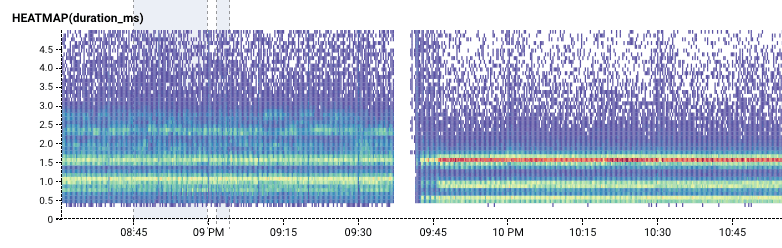
In this blog miniseries, I’m talking about how to think about doing data analysis, the Honeycomb way. In Part I, I talked about how heatmaps help us understand how data analysis works. In Part…
In this blog miniseries, I’d like to talk about how to think about doing data analysis “the Honeycomb way.” Welcome to part 1, where I cover what a heatmap is—and how using them can…
Rachel Perkins
If you’ve been paying attention, you know that although collecting and reviewing metrics and logs is a core part of running a stable and successful service, access to raw events and the ability to…
Ben Hartshorne
When we released derived columns last year, we already knew they were a powerful way to manipulate and explore data in Honeycomb, but we didn’t realize just how many different ways folks could use them.
Sam Stokes
Emily Nakashima
We’re all collectively trying to define observability (“o11y,” pronounced “olly”) these days, and, as Honeycomb is sometimes described as an event-based observability product, trying to define all the other words that go around o11y…
Christine Yen
If you think about it, mobile apps are among the production services most in need of real observability: nearly countless hardware platforms and operating systems in combination with your app’s code result in a…
Charity Majors
Everybody and their freaking grandpa is now claiming to do observability, not stodgy old monitoring. Fine, great. Nice to be trendy I guess. But are they? What’s the difference? You all know how I…
Travis Redman
At Honeycomb, we’re excited about Kubernetes. In fact, we’re in the early stages of moving some of our services to k8s. Tools like kops have made getting started with k8s easier than ever. But…
Guest Blogger
We’re grateful for this guest post from Tim Wilde! You can find the source code for the examples he uses in his github repo. Strings are where data go to die There you go;…
Observability has been getting a lot of attention recently. What started out as a fairly obscure technical term, dragged from the dusty annals of control theory, has been generating attention for one simple reason:…
Get it delivered straight to your inbox.
By subscribing to our newsletter, you agree to Honeycomb’s Terms of Service and Privacy Notice.
I went to Monitorama last year for my first time. It was great; I had a terrific time. But I couldn’t help but notice how speaker after speaker in talk after talk spent time…
This post continues our dogfooding series from How Honeycomb Uses Honeycomb, Part 5: The Correlations Are Not What They Seem. In a recent blog post, I talked about what sorts of things should go…
Nathan LeClaire
Golang as an Observability Tool Go, for good reason, has become an incredibly popular language for everything from web applications to DevOps tools. We lean on Golang heavily here at Honeycomb, and naturally we…
“Is observability just monitoring with another name?” “Observability: we changed the word because developers don’t like monitoring.” There’s been a lot of hilarious snark about this lately. Which is great, who doesn’t love A+…
This post continues our dogfooding series from How Honeycomb Uses Honeycomb, Part 3: End-to-end Failures. As Honeycomb matures, we try to roll out changes as smoothly as possible to minimize surprise on the part…
At Honeycomb, one of our foremost concerns (in our product as well as our customers’) is reliability. To that end, we have end-to-end (e2e) checks that run each minute, write a single data point…
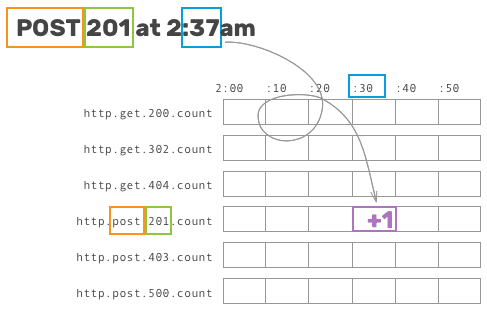
This is the third of three posts focusing on the limitations of pre-aggregated metrics. The first one explained how, by pre-aggregating, you’re tightly constrained when trying to explore data or debug problems; the second…
This is the second of three posts focusing on the limitations of pre-aggregated metrics. The first one explained how, by pre-aggregating, your flexibility is tightly constrained when trying to explore data or debug problems….