AI Norms & Values, Part 3 of 3: Things We Hold True
The final part of Honeycomb's AI Norms & Values series: the principles the company holds true about AI as a tool, ownership of work, and rising standards; how it actually uses AI day to day; usage patterns for respecting each other's time; and where it stands on AI's ethical externalities like energy use, IP, bias, and wages.

By: Charity Majors
AI Norms & Values, Part 1 of 3: How We Do Business at Honeycomb
It's been a year since Honeycomb issued its AI mandate. Charity reflects on what that produced, why AI isn't special (it just amplifies what's already there), and shares the first of three new documents on Honeycomb's AI norms and values: how we do business.
Read More
Welcome to the third and final part of our series on AI norms and values. Parts of this doc were extracted and published separately on substack; as a whole, they describe the principles we hold pertaining to technology and AI, and the ethical commitments we make to each other and our customers.
We set out to write about AI, and ended up writing about ourselves. These documents are not meant to be aspirational ones; they are derived from how we do our work every day in honeycomb.
This concludes the series, but not the discussion. Dr. Cat Hicks, author of The Psychology of Software Teams (out last month!), has contributed greatly to the industry's research and reasoning around how to build an excellent, high-performing, and deeply humane environment. Dr. Hicks and I will be continuing the conversation on our respective blogs over the next few weeks. We will also do a new episode of Leading With Observability and an open invite webinar where you can bring us your gnarliest questions about how to be a human in the AI era.
This is a weird time to be in computing. So much has changed, so fast. As a technologist, it's hard not to be dazzled by the possibilities, the speed, the range. As a human being, it's hard not to be tired.
On one hand, AI is just technology. On the other hand, this technology is different. Instead of the brute force of automation, AI presents an uncanny valley, a smooth facsimile of cooperation and cheer. I think this accounts for the creeping suspicion that we are not being treated like real people. But AI did not invent being rude, disrespectful, or careless with other people's time. For every problem amplified by AI, there are solutions AI can accelerate.
AI is not the point. The point is us.
Tools are just tools. An email can bring people together or tear them apart. AI can be used to avoid other people or to build and enrich communities. The difference consists of intent, understanding, consent, and good fit, not technology.
We are a company founded on values and first principles, and the stubborn conviction that technology can be so much better than people are used to. We're still doing that… just with AI.
Things we hold true
AI is a tool
AI is a powerful tool, but it is just a tool. We do not serve our tools. Our tools serve us.
You own your work
I am not a “human in the loop,” I am the owner of the loop. It's my fucking loop. I am responsible for the quality of my work and the integrity of my working process, and so are you. “Claude did it” or “Claude said” is not an excuse.
The bar is going up
Every technological transition resets the baseline for performance—not by mandate, but by what becomes possible. This is true for companies, products, teams, tools, and people. What was excellent five years ago is table stakes today.
We welcome this. The nature of technology is that it always catches up. Which is why the nature of technologists is, we stay ahead.
The outcome is what matters
A higher bar means better outcomes. Often this is about moving faster, but not always, and never exclusively. What outcome are we aiming to achieve? What would ‘better’ look like? What would ‘great’ look like? What is possible today that wasn't possible last year?
For outcomes to matter, we must embrace measuring ourselves. Everything is an experiment, but an experiment that doesn't get tracked is wasting everyone's time.
How we use AI
A shortcut or a deep dive
You can use AI to help you do something fast and half-assed, or you can use AI to help you think harder, build with more rigor, communicate with more depth.
There is a time and a place for both, but the two are not interchangeable. Know the difference.
AI for the role, AI for the self
You may use AI at work in ways that are prescribed by the company to do your job, and we owe you enablement and support for those.
You may also use AI of your own volition for calendar support or editing, as a tutor, rubber ducky, etc. This is much more personal and subjective, and no one is required to do it, but opting out of using AI does not exempt us from the higher bar.
More AI is not always better
AI is not the right tool for every use case, and more AI is not always better. If AI is causing friction and frustration in a given setting, talk with your team about how to reduce or eliminate that frustration. Make the tools serve you.
Master the tools before ruling them out
However, be careful to make this decision from a place of fluency, not ignorance, and revisit your decision occasionally. It's easy to blame the tools for the frustration of learning.
Usage patterns
AI should make our signal-to-noise ratio better, not worse. To do this, we need three things: self-awareness, respect for each other's time, and open dialogue.
Address the envelope
Any time you send someone an artifact, tell them what it is, why you're sending it, and what you hope to receive from them, and any other useful context you can think of.
This is the “envelope” of your message. Addressing the envelope does a couple vital jobs:
- It cultivates self-awareness. When you drop a large artifact on someone and walk away with no comment, it's easy to breeze past the fact that you may have just dumped a ton of work on someone. This surfaces as frustration with AI because AI has newly made this easier, but AI is not at fault. You own your work. When you describe your request in detail, it forces you to think through what you are asking them to do and what you really need from them.
- It opens a conversation. When someone drops a link on you, it can feel like a demand, but it's not. We don't assign work at Honeycomb, we ask nicely, and if someone has concerns or objections, we talk about them. This should always be a conversation. “This is what I have, this is what I need. Are you the right person? Is this the right time? What questions do you have?” Ask. If someone sends you an artifact or a request and you feel a pit in your stomach, pay attention to it. What is it you fear?
Respect other people's time and attention
Never send someone an AI-generated doc unless you have first read it yourself, every word. If it's not worth your time and attention, how can you possibly say it is worth someone else's? This may be a low bar, but it's an important one.
To respect other people's time and attention, make the smallest necessary ask. You wouldn't ask someone to read a whole book when you need them to read page 152. Specificity is kindness, boundaries are respect.
Four types of communication
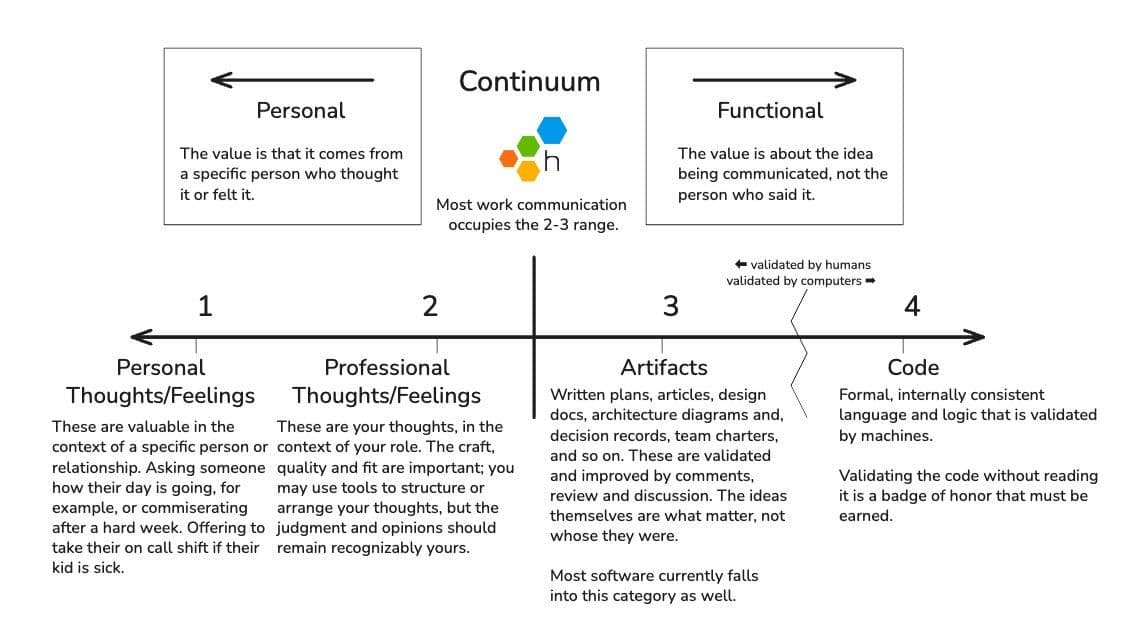
This four-point scale can be used to plot whether the value of any communication is primarily personal or functional. On the left, the value is in that it comes from a specific person who thought it or felt it. On the right, the value comes primarily from the ideas or artifact itself.
Personal to the left, functional to the right. Like this:
1: Personal opinions
The value of this communication is that a specific person thought it or felt it, or that it exists in the context of a relationship. You aren’t upset when a stranger doesn’t wish you happy birthday, but you might be upset if your partner doesn’t. When an expert in your field compliments your work, it means a lot because you respect them.
Using AI in this context tends to destroy trust instead of building it, unless AI has explicitly been welcomed in to the relationship. (“Wow, my manager even used AI to tell me happy birthday? What an asshole.”)
2: Professional opinions
Most professional communication goes here. Some of its value comes from you being the person who thought it or felt it, but not all—the quality, relevance, skill and fit of the message also matter.
- If you gave advice, how good was it?
- If you wrote a review, was it clear, useful and fair, and was the content not a surprise?
- If you shared your opinion, how expert, well-crafted and timely was it?
It’s fine to use AI and other tools to arrange, structure or enhance these thoughts, but they should remain recognizably yours. If someone wants your opinion, or asks you to give a talk, they want your opinion, in your voice. When your voice is lost in the response, it may register as a breach of trust.
3: Prose artifacts
On the other hand, there are artifacts. An artifact’s value does not derive from being something a particular person thought or felt, it comes from the ideas themselves. Artifacts include docs like PRDs, architecture diagrams and decisions, strategy docs, meeting notes, and much more. Sometimes code fits in this category too.
Artifacts get reviewed by reading, and validated by tools like comments and discussion threads. An artifact usually has an owner, but our goal is to collaboratively make the ideas better, regardless of ownership or authorship.
4: Software artifacts
Formal, structured information like software can be verified automatedly in ways that written and spoken languages cannot. Wherever we can defer to the machines for testing, we probably should; validating logic at scale is hardly where humanity shines.
However, merging source code without reading it is a badge of honor that must be earned. Today, most software at Honeycomb continues to be validated using a blend of techniques from 3 and 4.
Ask for what you want
While it may not always be entirely clear whether a given piece of feedback is more subjective or objective, it is usually extremely clear to people what they want. When they want someone’s personal, subjective opinion vs when they are reaching for “the best idea.”
If you know what you want: ask for it. If you aren’t sure what someone wants you to give them: ask.
How to handle mismatched expectations
An enormous amount of frustration is being generated right now by mismatched expectations and uncertainty. It is tempting to blame AI and start micromanaging and issuing rules over who can use AI in what ways, in which contexts.
But we hire adults. That is not our way. AI is just a tool, and our tools serve us.
The “reasonable effort” example
It would be incredibly rude for me to spend five minutes generating a piece of code and then drop it in someone’s lap, expecting them to spend two or three hours reviewing it.
But what if I spent five minutes generating a piece of code, and sent it to someone saying, “Hi, I just spent five minutes on this, and I was wondering if you were available to spend no more than five min giving me a gut check on it. Am I headed in the right direction?”
That seems fine, right?
The opinion example
Or what if I ask someone for feedback on my written plan, and they respond by generating a variation of my plan with Claude, and sending back an entirely new artifact. This would be frustrating if I wanted their opinion, because now I have a whole new plan to digest and I still am not clear on what they think. What should I do?
Well, you could engage with the content in a number of ways. You could ask to see their prompt, or re-state your request with more specificity, or you could waste a lot of time trying to tease out what they changed on purpose and what came along for the ride.
But this is a pretty basic case of missed signals. The better strategy is probably not to engage with the content at all, and deal with the mismatched expectations instead. Politely tell them what you actually need, and ask if they can give it.
The performance review example
One of the trickiest things to navigate is when you get peer feedback or a performance review that smells AI-generated, and you aren’t sure how to value it. Does it mean anything? Which parts came from them, and which were filled in by the AI? Did they even read it before they gave it to you? Will they get mad if you ask?
This can be deeply corrosive to trust, so it’s critical that we make space for these conversations. This cannot be a taboo topic. Managers, bring this up with your reports. Talk about your process. Make it safe to ask questions and venture feedback.
We actively encourage managers to use AI to build systems that help them be better managers—recording how they show up in meetings, coaching them on hard conversations, tracking their team members’ achievements.
There are countless valuable ways to use these tools. But they do not, cannot, must not supplant or replace the manager’s judgment. There is no world in which a manager can push a button and generate a performance review, skim it and hand it to their report. That is unacceptable. If your job can be automated away so easily, what do we need you for?
Writing is thinking on paper, as William Zinsser said. While there are many ways that using AI can save us time and energy, the way we train the LLMs between our ears is by doing things, trying things, and yes, writing things. That takes work. Make sure you are doing the work you need to do to develop the good judgment we rely on you to have. Never shortchange your direct report or yourself by outsourcing that work to the machines.
Give feedback in your voice
And do your best, managers, to give feedback in your voice. People are developing a sixth sense for AI-generated text, and many people just stop reading. (Guilty.) It can feel like a real betrayal when you expect personal communication and sense you aren’t getting it.
But—and this is also important—it does not have to feel like a betrayal. It does not have to be a betrayal. The key is context, understanding, and trust. A manager who uses English as a second language might remind their reports that they use Claude as a courtesy gloss. A manager with strong AI-first systems could talk to her reports about her process and see if they buy into an experiment with auto-generated reviews.
Teams legitimately vary in their tolerance and enthusiasm for this, but there are options. With people and communication and ingenuity, there always are.
Executive functioning is more important than ever
So much of this comes down to expectations and being explicit: Here is what I have, here is what I need. Are you available for that?
I have had and heard about so many of these exchanges by now. I have felt the same seething frustration at having my time wasted. But when I track down the person on the other side, it’s invariably one of two things: either they weren’t aware how much time consuming, frustrating work they were generating for me, or they were causing the frustration in an attempt to be helpful.
The number of times they were trying to push work off their plate onto mine, or force me to spend hours cleaning up after their mess is an absolute zero.
We do not work with assholes, y’all. But we also do not work with mindreaders. We are used to taking so much for granted, and now we can’t.
The provenance of a document is always relevant
Asking about how a doc was written or generated is hard when there’s a power dynamic, so managers have an extra dollop of responsibility. But no one is off the hook. No one gets in trouble for asking questions about whether something was AI-generated or human-made—it’s an important and relevant piece of context. And everyone should cheerfully disclose when asked.
Which brings us to one final note of caution.
If you feel uncomfortable about how you made the artifact, and you don’t want the recipient to know how you made it…
That is an important signal. I suggest you honor it.
Ethical issues we have a stance on
There are two specific mistakes we are trying to avoid in writing this section.
We don't want to write something glossy and aspirational about how much we “Care About Ethics™” with no evidence to back it up, but we also don't want to make commitments we can't keep. Instead, we will affirm some of the principles that have gotten us this far, and describe how they have guided our decisions in the past.
Externalities and harms done by AI
There are a number of troubling externalities associated with AI:
- Energy usage/carbon footprint
- IP theft
- Privacy
- Bias
- Job cuts, wage cuts, and disinvestment in the next generation
We are a for-profit company, and our first priority is to build a successful, sustainable business. When we succeed at business, we earn the right to think longer term and make bigger investments.
Our vendor review process includes an ethics review. We preferentially give our money to vendors that share our values or are the lesser of two evils. We will continue to do so.
On energy and resource usage
We frankly have no idea what to do about this, as a consumer (not producer) of foundational AI models. Which is unfortunate, since it is probably the most alarming externality. We will re-examine in six months.
On intellectual property
This is a thorny one. It appears that model providers have knowingly violated copyright law for years with no brakes and no consequences, outcompeting (and dooming) competitors who followed the law. Was it illegal? Sure seemed that way. But the only honest answer is we don't know, and we won't know, until we learn how the Supreme Court will interpret the law.
But was it right? Absolutely not. It was settled law at the time, and they systematically broke it. To retroactively bless this behavior sets a concerning precedent for businesses like ours who believe in fair competition and following the law.
Ethics, morality, and the law have always been different things. As model users, we are aligned with the letter and spirit of the laws. But we benefit from the unsavory acquisition of training data, and we know it, which incurs a moral debt.
At a minimum, we should be diligent in citing references, assigning credit, and compensating contributors whose work we use in commercial activity, above and beyond what is legally required of us. All of which we have a track record of doing, and will continue to do.
On bias and privacy
“You own your work” means that any bias introduced by AI is your problem. Be mindful of where bias tends to creep in, and guard against it. Verify results where possible. Welcome feedback warmly, correct, and move on.
It is not clear how we can contribute to privacy efforts.
On wages and disinvestment
We have never been a company that believes in squeezing the most work out of people for the least money. We compensate as well as we are able, and we take fair pay very seriously.
We have always felt a responsibility to invest in the people who work here, just as they invest in us. This includes hiring and training entry level workers when we are able to do so.
Mentoring and learning are at the heart of our job ladders in R&D, and the SDR pipeline serves a similar purpose on the GTM side. We have supported a number of employees in retraining for different roles. Personal development budgets are widely used. We audit our salary bands for bias and equity, and practice transparency around pay bands in job postings.
We have learned the hard way that it does not serve anyone for us to hire junior employees when we aren't ready to support them, but when we can support them, we have and we will.
On activism vs working agreements
These ethical stances may seem relatively modest, and they are. These are working agreements for doing business, not ethical aspirations or activist goals.
There is a place for activism. There is a place for outright advocacy. At a time like this, we would all be well served to consider our ethical stances and how to act on them. Business may not be the ideal vehicle for activism, but activism is vital and necessary. People who take action in support of their beliefs (generally within the confines of the law) will not be retaliated against at Honeycomb.
We are here to build a business. There is virtue in this, even if it is not explicitly ideological.
Closing statement
The workplace is one of the last remaining places where people of widely varying backgrounds and beliefs all come together to achieve something greater than themselves. We think this is precious. We think this is worth protecting.
We believe that treating people well is not at odds with the profit motive. We believe that people who are happy, healthy, well supported, and creatively engaged can do better work.
We believe that rigorous use of AI helps a company like ours accelerate development, delight customers, and go head to head with competitors with vastly more resources. We believe that using AI is not a replacement for skill and craft, but an amplification.
We believe that customers who are valued, respected, and listened to are happier, more loyal customers. Happy customers are more invested in giving us the feedback we need to build a better product. We believe in building mutually beneficial relationships and positive feedback loops that leave both sides better off.
We do these things, not as a sacrifice or a distraction from our core mission, but in service of it.